
PPR Launch Housing Inequality Report
ALARMING REPORT HIGHLIGHTS REPEATED FAILURES TO ADDRESS CATHOLIC HOUSING INEQUALITY IN NORTH BELFAST
Wide-ranging Ministerial, Statutory and Council Failures Compound Inequality
"The Committee is concerned about the chronic shortage of housing, in particular social housing, for the most disadvantaged and marginalized individuals and groups, such as... Catholic families in Northern Belfast, in spite of the financial resources provided, and other measures taken, by the State party in this regard." Concluding Observations of the United Nations Committee on Economic, Social and Cultural Rights, May 2009
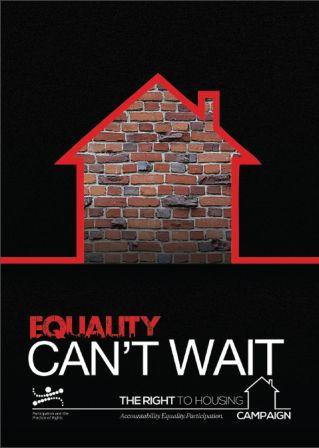
Thursday 22 August 2013 – An alarming report released today by the Participation and the Practice of Rights organisation (PPR), entitled ‘Equality Can’t Wait’, evidences how a series of Ministerial, statutory and council failures have compounded religious inequality in housing across North Belfast.
The report evidences that these failures have adversely impacted on the Catholic community. It also outlines initiatives which could lead to housing need being redefined, which will impact on social housing applicants across Northern Ireland.
The Participation and the Practice of Rights organisation (PPR), founded by renowned human rights activist, the late Inez McCormack, was recognised by the United Nations in November 2012 for its work on housing in Northern Ireland.
Kate Ward, Policy and Research Support Officer with PPR, discusses the report:
“The Catholic community in North Belfast has long been impacted by religious inequality in housing. PPR has worked on housing issues with people on the ground in North Belfast over the last seven years. Our work is showing that Catholics in North Belfast in need of housing have been repeatedly disadvantaged. This includes the failure of the £133 million North Belfast Housing Strategy to tackle inequality; the engineering of a Belfast City Centre ‘shared space’ being prioritised over addressing existing Catholic housing need; and the removal of protections which ‘ring-fenced’ new social homes for areas impacted by religious inequality.
“Religious inequality in North Belfast housing has been highlighted at the international level. In May 2009, the high level United Nations Committee on Economic, Social and Cultural Rights, called on the UK government and Northern Ireland Executive to act to address “the chronic shortage of housing, in particular social housing, for the most disadvantaged and marginalised individuals and groups, such as...Catholic families in Northern Belfast”.
The existence of two d ifferent sets of figures held by the Northern Ireland Housing Executive (NIHE) in relation to housing inequality in North Belfast is also covered in the report. In 2009, one set of figures showed that Catholics in North Belfast made up 73% of those in housing stress, with the other putting the figure at 57%. After 2009, the methodology which put the percentage of Catholics in housing stress at 73% ceased to be used by the NIHE.
Ms Ward adds:
“The report also considers the fate of two ‘windfall’ sites in North Belfast, which should have been used to tackle the chronic need for homes in North Belfast. The issue of housing inequality was not on the agenda at all for the Department of Social Development (DSD), Department for Regional Development (DRD) or the Belfast Harbour Commission in relation to the Belfast Harbour’s 20 acre site and as a result the majority of housing there will be private. In addition, the report brings to light information relating to the now renowned Girdwood Barracks site in North Belfast, where the tackling of Catholic housing need was considered ‘divisive’ so the housing composite of the site was deemed subject to cross-community agreement, rather than being required by law to meet the greatest need.”
The research also unveils evidence that recent NIHE and Department of Social Development policy decisions will result in a redefinition of ‘objective need’ – the fundamental principle upon which social housing across Northern Ireland is allocated.
"Any decision on housing in North Belfast has to evidence how it will concretely address the inequality experienced, in this case, by the Catholic community. Attempting to build good relations on the basis of denying the needs, frustrating the rights, and silencing the voices of the poorest is wrong in itself as it is destructive to the goal of building a shared future." Inez McCormack (PPR Founder, May 2012)
The ‘Equality Can’t Wait’ report finds the legal obligation to address religious inequality and meet housing need, which are cornerstones of the peace settlement, are not being met in a number of areas:
- The desire to build new housing areas with a ‘balanced’ religious composition has been prioritised over addressing housing inequality. Despite noting the chronic housing inequality impacting on the Catholic community in North Belfast, the NIHE proposed a new Belfast City Centre Waiting List be created which would be engineered to be a ‘shared space’. This will lead to a large number of the Catholics in housing stress on the doorstep of Belfast City Centre being passed over for housing in this area.
- A review of the social housing allocations policy across Northern Ireland was announced in the DSD’s ‘Facing the Future’: Housing Strategy for Northern Ireland 2012-2017’ document. The Terms of Reference for the Review state it is to consider, amongst other things “access to the social housing waiting list for those applicants with little or no demonstrated housing need.”
- Initiatives are under way that will lead to social housing not being targeted at areas where people need it most, but where there is actually negligible demand on the social housing waiting list. The plans for the Housing Led Regeneration Pilot announced in August 2013 by the DSD, proposes the possible building of new social homes in majority unionist Lower Oldpark and Tigers Bay, despite there only being 24 applicants in housing stress. In adjacent majority nationalist communities of New Lodge and Cliftonville, there are 368 applicants in housing stress (NIHE, 2012).
Commenting on the report’s findings Kate Ward says:
“The festering sore of religious inequality in housing must become a priority for the Minister for Social Development, and more widely the Northern Ireland Executive.”
“Behind the figures and statistics are people who have been living in poor housing conditions for a long time, with little hope for change. With the upcoming reform of the Northern Ireland Housing Executive, and the launch of Northern Ireland’s first Housing Strategy, the time to act is now. The ‘Equality Can’t Wait’ report calls on the Minister for Social Development to put in place a timetabled and resourced strategy for eradicating religious inequality in North Belfast, and review key policies affecting social housing residents across Northern Ireland to ensure they comply with the statutory obligation to address inequality. All those with influence must act to ensure these vital equality provisions, which are core to the Good Friday Agreement, are implemented without delay.”
Thomas Hammarberg, former Council of Europe Commissioner for Human Rights (2006-2012), who visited North Belfast residents in December 2011, states in the foreword of the 'Equality Can’t Wait' report:
“The Northern Ireland peace agreement was unique in how it created provisions which mainstreamed human rights and equality into the everyday operations of government. Promoting rights and equality was recognised as a bedrock for a sustainable peace process. However, such provisions have to be translated into improved outcomes for the most vulnerable in our society, such as the residents I met in North Belfast. The people with responsibility for implementing and upholding human rights and equality have to be held accountable.”
Click here to view 'Equality Can't Wait: Key Facts and Dispelling the Myths'.
Click here to view the Equality Can't Wait report.
Click here to download Equality Can't Wait report.
To listen to PPR's Kate Ward discussing the report on BBC Good Morning Ulster, please click here.